Geological Sites of Jiulongji
编辑: 小编 时间:2026-04-25 16:51:01 浏览次数:
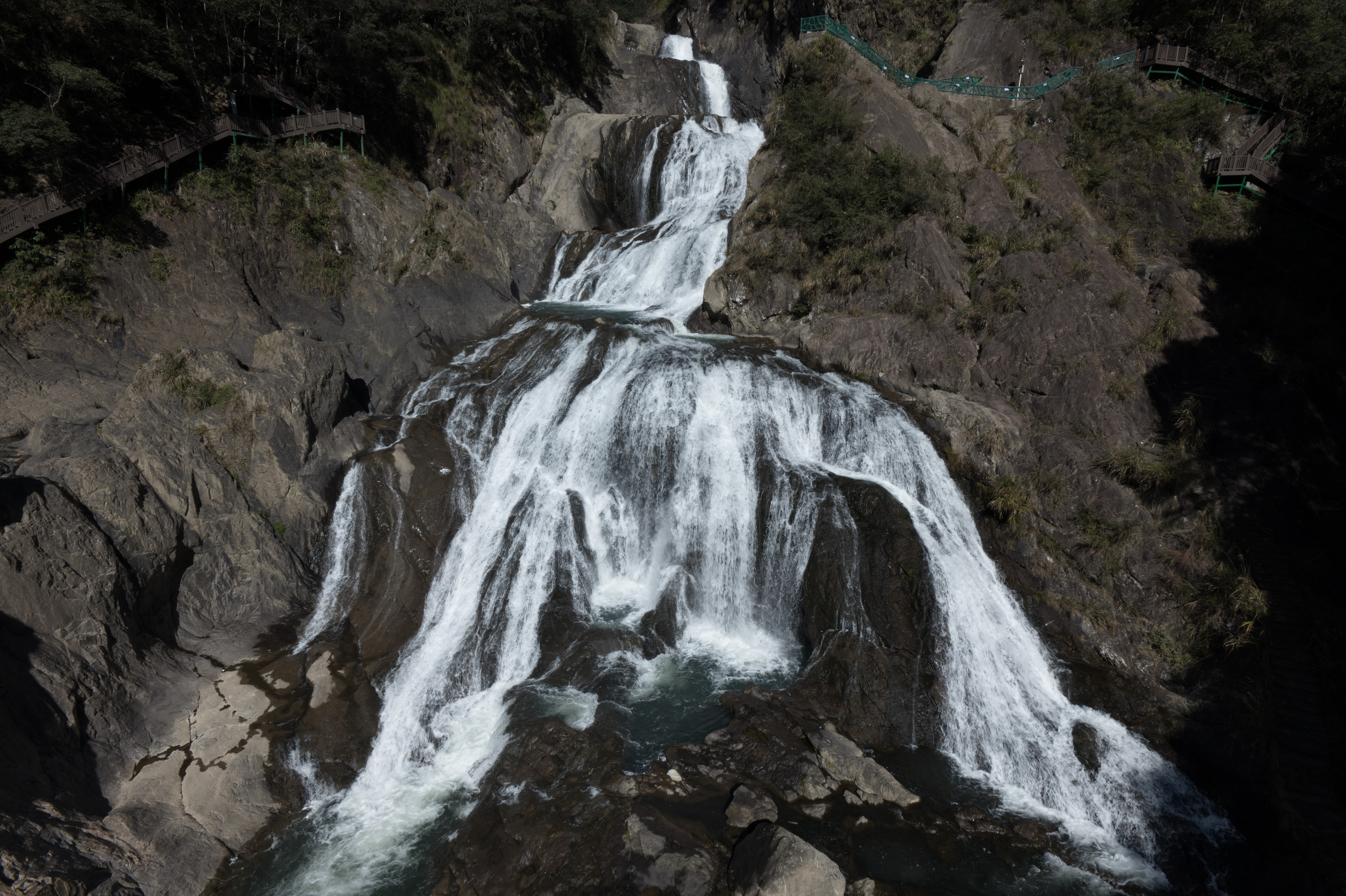
Jiulongji is featuring deep ravines and nine-tier waterfalls shaped by prolonged water erosion. The nine-tier waterfalls are interlinked, forming a harmonious and staggered arrangement. The main Jiulongji Waterfall boasts a 46.7-meter drop, with waters cascading like a jade loong. The other falls vary in character—some gentle, others turbulent—each with distinctive shapes, collectively creating a rare waterfall group. Its formation is closely tied to differential crustal uplift, making it a significant site for studying neotectonic movement and water erosion landforms.
1.Jiulongji Grand Waterfall
With a drop height of 46.7 meters and a width of 75 meters, extending to 83 meters in the wet season, it is the most precipitous, highest and most spectacular tier among the Jiulong stepped waterfall group. In summer’s high-water period, mountain water surges down from the cliff top with thunderous roars and overwhelming momentum. Foams surge over the pool surface, while dense water mist hangs in the air like fog and drizzle. Standing on the viewing platform, massive heat absorption by water vapor generates powerful air waves mixed with mist, bringing a stunning, refreshing and breathtaking sensory experience.

2.Longwa Waterfall
The riverbed rocks are fractured by nearly east-west tensile joints and fissures. Flowing water erodes laterally along the fissure grooves, forming a small waterfall with a slightly convex middle and circulating currents on both sides, resembling frogs playing in water. The waterfall is 8.4 meters high and 7 meters wide. There are potholes downstream, whose top surfaces are slightly above the water level, gradually widened and deepened by water erosion along fissures.
3.Long'e Waterfall
Named for the dense east-west joints on brown rocks that closely resemble a crocodile’s carapace, the waterfall is 11.5 meters high and 51 meters wide. Broken rock masses result in an irregular and disordered waterfall surface with a small drop, dividing the current into scattered streams.
4.Longya Waterfall
A jagged loong-tooth-shaped rock in the middle splits the current into a herringbone flow plunging into Wolong Pond, hence the name. It is 22 meters high and 26 meters wide. Vertical movement of an east-west fault formed the steep scarp above the waterfall. The central rock of the scarp remains partially intact, creating the iconic "loong tooth".
5.Wolong Waterfall
This waterfall is 13 meters high and 48 meters wide. The rushing current from loong Tooth Waterfall converges into a pond covering over 2,000 square meters to form this fall. Unlike the turbulent upper waterfalls, it flows gently and peacefully like a resting crouching loong, giving rise to its name.
6.Longtan and Longjing Waterfall
It is named Longjing Waterfall for three undercurrents emerging from the bottom of the pool beneath the fall, with a height of 14.4 meters and a width of 24 meters. Intense vertical movement of dense east-west faults and joints formed two connected steep scarps, making it the most precipitous and perilous of the nine waterfalls. As the current flows southward across the waterfall top, the river narrows sharply into a powerful water column pounding the loong well with deafening sounds.
7.Longjiao Waterfall
Jagged rocks stand in the waterfall. Strong current carrying sand and gravel scours the rocks’ edges and bases, polishing them glossy. The protruding rocks look like loong horns, thus the name called Longjiao Waterfall. The waterfall is 22.4 meters high and 62 meters wide. It consists of two connected scarps forming a 20-degree included angle. With the dragon horn-shaped rock standing in the center, the stream pours down in a curved fan shape.
8.Longkou Waterfall
The waterfall is 17.7 meters high and 69 meters wide, with a hidden water curtain cave behind it. Water gushes out like a giant loong opening its mouth. Together with the three upper waterfalls, it forms a huge water screen 69 meters wide and 37 meters high. Fragmented rocks along joints and fissures were worn away by water flow, gravity and weathering, forming a cave opening 2 meters in diameter and 50 centimeters deep. Meanwhile, northwest faults and joint cutting created a southeast-dipping steep scarp.